

It’s 2:43 AM.
The world is quiet.
The lights in other houses are off.
Even your phone feels silent.
But your mind isn’t.
You’re not just “unable to sleep.”
You’re not necessarily sick.
You’re not broken.
You may be experiencing something many people quietly go through — emotional insomnia.
Table of Contents
What Is Emotional Insomnia?
Emotional insomnia isn’t a medical diagnosis.
It’s a pattern.
It happens when your inability to sleep is deeply connected to your emotional state — especially loneliness, unresolved thoughts, anxiety, or feeling unseen.
Unlike traditional insomnia that may be caused by physical factors, emotional insomnia tends to show up when:
- You feel alone at night
- Your mind replays conversations
- You suddenly feel empty before bed
- Silence makes your thoughts louder
- You feel more vulnerable after dark
Daytime might feel manageable.
But nighttime removes distractions.
And what’s left is you — and everything you didn’t process.
Why Does Insomnia Feel Worse at Night?
During the day, your brain is busy.
Notifications. Conversations. Tasks. Movement.
At night, stimulation drops. Cortisol decreases. The environment becomes still.
For someone carrying emotional tension, that stillness becomes amplifying.
Silence doesn’t calm you.
It exposes you.
Many people report:
- Overthinking increases after 11 PM
- Sadness feels heavier at night
- Anxiety becomes more physical
- A sense of isolation intensifies
This is not random.When external noise fades, internal noise becomes clearer.
The Link Between Loneliness and Sleeplessness

Loneliness is not just a social condition.
It’s a nervous system state.
Research shows that perceived social isolation can increase hypervigilance — your brain stays alert because it feels less safe.
In evolutionary terms, humans slept better in groups.
Feeling alone can subconsciously signal vulnerability.
So your body stays slightly “on guard.”
This can lead to:
- Light sleep
- Frequent waking
- Difficulty falling asleep
- A restless mental state
Emotional insomnia is often not about sleep itself.
It’s about feeling unsupported in your internal world.
Signs You Might Be Experiencing Emotional Insomnia

You may relate to emotional insomnia if:
- You sleep fine when emotionally content, but not when distressed
- You scroll your phone to avoid silence
- You wish someone was there to talk to at night
- You feel calm during the day but anxious at bedtime
- You don’t necessarily feel tired — just unsettled
This type of sleeplessness often feels less like “I’m not tired” and more like:
“I don’t feel safe enough to let go.”
Emotional Insomnia vs. Clinical Insomnia
Clinical insomnia often involves:
Clinical insomnia is medically defined as persistent difficulty initiating or maintaining sleep that causes daytime impairment, according to the American Academy of Sleep Medicine.
- Chronic difficulty sleeping regardless of mood
- Sleep disruption for 3+ months
- Daytime functional impairment
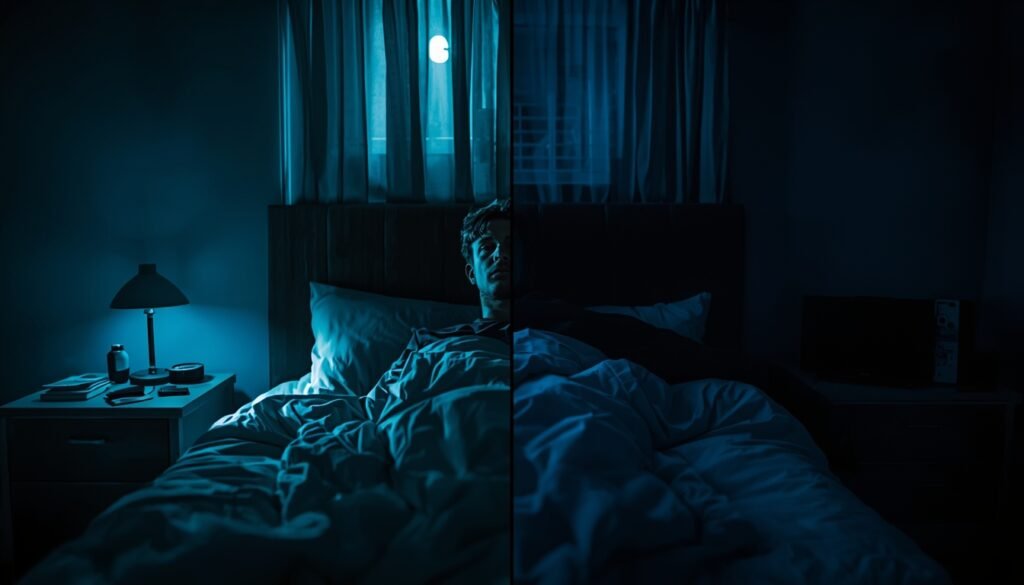
Emotional insomnia, on the other hand, fluctuates with your emotional state.
If you’ve ever noticed:
“When I feel connected, I sleep better.”
That’s a clue.
However, if your sleep issues are severe or persistent, seeking medical evaluation is important.
This article is not medical advice — it’s emotional perspective.
Why Nighttime Makes Emotions Louder

Night removes performance.
You don’t need to be productive.
You don’t need to appear strong.
You don’t need to respond to anyone.
So your guard lowers.
For many people, this is when:
- Suppressed sadness surfaces
- Relationship doubts replay
- Existential thoughts appear
- Old memories resurface
The brain shifts into introspective mode.
The brain shifts into a more internally focused state at night, which can amplify emotional processing, a pattern often discussed in mental health resources from the National Institute of Mental Health.
And without emotional grounding, it can spiral.
Gentle Ways to Support Emotional Insomnia

You don’t need to “fix” yourself.
You need support.
Here are small interventions that help many people:
1. Externalize the Mind
Write down the looping thought.
Not to solve it.
Just to move it out of your head.
2. Reduce Absolute Silence
If silence amplifies your thinking, try:
- Soft ambient noise
- Gentle instrumental music
- Low-volume podcasts with calm voices
Some people find comfort in background sound machines or sleep headphones because they soften mental space rather than eliminate it.
3. Create a Night Ritual of Safety
Dim light.
Warm drink.
Same routine nightly.
Consistency signals safety to the nervous system.
4. Read Words That Feel Human
Reading something emotionally grounding can reduce the sense of isolation.
Not productivity books.
Not self-improvement.
But something that feels like company.
You Are Not Strange for Feeling This Way

Many high-functioning people experience emotional insomnia.
They appear composed.
But at night, the internal world opens.
This doesn’t mean you’re weak.
It means you feel deeply.
And depth without companionship can become heavy.
If You’re Awake Right Now

You’re not the only one.
Somewhere, someone else is also staring at the ceiling, feeling too aware.
You don’t need to force sleep.
You don’t need to silence your thoughts aggressively.
You need gentleness.
And sometimes, that starts with simply recognizing:
There is nothing wrong with you.
You are not broken.
You are human in the quiet.
Continue Reading
If this resonates with you, you may also want to explore:
- Why Overthinking Gets Worse at Night
- Can Loneliness Cause Insomnia?
- Why Silence Feels Louder at 3AM