
Disclosure: This research article contains affiliate links. If you make a purchase through these links, we may receive a small commission at no additional cost to you, which supports our independent sleep ergonomics research.
Have you ever had a morning where, instead of waking up feeling refreshed, you woke up with a stiff neck, sore shoulders, and even a dull headache?
In a recent survey by loverschoice.net, we found that over 60% of adults consider their pillows “good enough,” yet nearly half of that same group reported waking up in the middle of the night or feeling tired in the morning. Research shows that improper sleeping positions can alter the natural curvature of the cervical spine, leading to persistent muscle tension and even obstructing the airway due to improper head positioning, which can trigger loud snoring.
This isn’t just a personal health issue. A 2026 trend report indicates that approximately 35% of couples choose to “sleep apart” due to their partner’s snoring or disruptive tossing and turning.
An unexpected discovery: What you need isn’t a softer pillow, but “physiological alignment”
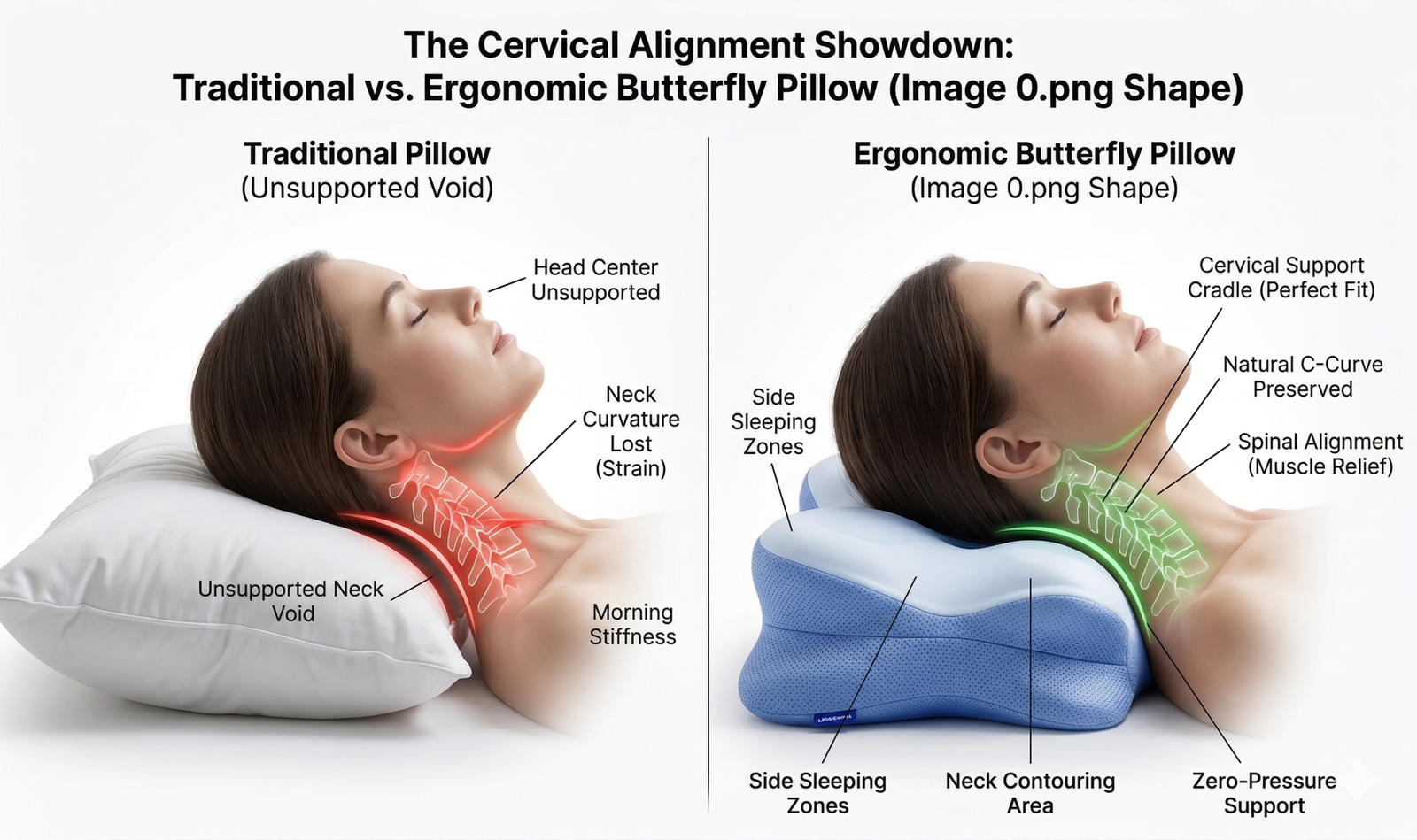
After reviewing numerous clinical trials on cervical alignment, our laboratory identified a critical issue: traditional filled pillows (such as down or standard polyester fiber) undergo unpredictable displacement when compressed. This means that during an 8-hour sleep cycle, your head and neck are actually in an unstable state—either “suspended” or “over-flexed.”
The scientific community agrees that the ideal solution is to maintain the natural forward curve of the cervical spine (cervical lordosis). Only when the cervical spine is in a neutral position can muscles fully relax, nerve compression be relieved, and the airway remain maximally open—thereby supporting smooth breathing and reducing snoring.
The Search for the Perfect “Support Geometry”
As sleep researchers, we compared various products on the market that claim to “support the neck.” After testing material resilience, anatomical fit, and breathability, a pillow featuring a unique geometric cut design—the Derila Ergo—caught our attention.
Unlike traditional rectangular pillows, the design of the Derila Ergo is based on precise ergonomic principles:
- Butterfly-shaped support wings: Specifically designed for side sleepers, these fill the gap between the shoulders and neck to prevent spinal misalignment.
- Memory Foam Core: Utilizing the temperature-sensitive properties of high-density memory foam, it perfectly molds to the user’s unique head and neck contours, providing even pressure distribution.
- Optimized Breathing Channels: Through a specific neck contour angle, it supports the head’s natural extension. Studies indicate that this slight elevation effectively expands the oropharyngeal space, reducing noise caused by obstructed breathing.
Why is Derila Ergo the “Lovers’ Choice” of 2026?
In our in-depth review, Derila demonstrated three undeniable advantages:
- Immediate physical relief: Most testers reported that the “stiffness” in their neck upon waking disappeared as early as the first night after switching to Derila.
- Improved sleep quality for partners: Thanks to its support for the airway, many partners reported a significant reduction in “noise disturbances” during the night, enhancing harmony in the shared bedroom.
- Compatibility with all sleeping positions: Whether you prefer sleeping on your back or side, its multi-layered design provides precise support.

Conclusion: Invest in Your Late-Night Recovery Time
Sleep accounts for one-third of our lives. Rather than spending thousands of dollars on a new mattress, start with your pillow—the item that most directly affects your respiratory and nervous systems. If you’re tired of waking up with aches and pains, perhaps it’s time to give your cervical spine a chance at “scientific alignment.”
Disclaimer: These statements have not been evaluated by the FDA. This product is not intended to diagnose, treat, cure, or prevent any disease. The information provided is for educational purposes and should not replace professional medical or orthopedic advice. Results may vary depending on individual body types and sleep habits.